When Roy Orbison Passed Away, What Was His Net Worth?
Roy Orbison Net Worth details remain unverified. See his income sources, royalties, and financial legacy based on reliable historical records.
Author:Chloe AndersonApr 06, 2026258 Shares18.4K Views

Roy Kelton Orbison was born on April 23, 1936, in Vernon, Texas. He was the son of Orbie Lee Orbison and Nadine Orbison. His mother, Nadine, was a nurse, and his father worked as a mechanic. Roy was the second of their children and spent his childhood in West Texas.
During World War II, his parents moved the family to Fort Worth for defense factory work. In 1944, a polio epidemic led Roy and his older brother to live with their grandmother in Vernon. After the war, the family returned to West Texas and settled in Wink, a small oil town.
Orbison showed an interest in music from a very young age. For his sixth birthday, his father gave him a guitar, even though Roy had asked for a harmonica. His father, Orbie Lee, and other family members taught him how to play. By the age of eight, Roy had already written his first song, “A Vow of Love,” in 1944.
Around the age of nine, he entered a singing contest on the local radio station KVWC in Vernon and won, earning his own weekly radio show. These early experiences learning guitar and performing on the radio shaped Orbison’s childhood and deepened his connection to music.
Orbison attended Wink High School in Wink, Texas. While still a teenager, he co-founded a country band called the Wink Westerners. He graduated from Wink High School in 1954. After high school, he briefly attended North Texas State College in Denton for two semesters. This marked the extent of his formal education before he went on to pursue a career in music.
| Fact | Verified Insight |
| Net Worth Status | Not publicly disclosed |
| Primary Income Sources | Music sales, royalties, licensing |
| Date of Death | December 6, 1988 |
| Breakthrough Success | “Only the Lonely” (1960) |
| Biggest Hit Song | “Oh, Pretty Woman” (1964)v |
| Vocal Ability | Multi-octave tenor voice |
| Unique Style | Dramatic, non-traditional structure |
| Awards & Recognition | 5 Grammys, Hall of Fame |
| Comeback Era | Traveling Wilburys, 1980s |
| Lasting Legacy | Influential rock vocalist |
Early Career And Musical Beginnings
Roy Orbison began performing in his native Texas as a teenager. He co-founded his first band, the Wink Westerners, by age 13 and gained experience on local radio and live shows.
After high school he continued to record and write songs; he teamed with friends to cut the rockabilly tune “Ooby Dooby” (first at a Dallas studio and later at Norman Petty’s Clovis studio). This led to Orbison’s first contract with Sun Records in Memphis, where the Sun pressing of “Ooby Dooby” became his first minor chart entry in 1956.
In Nashville he focused on songwriting, and one of his early compositions the country-style ballad “Claudette” was recorded successfully by the Everly Brothers in 1958. Orbison’s persistence paid off when he signed with Monument Records in 1959, setting the stage for his breakthrough as a solo artist.
Breakthrough Success And Rise In Rock And Roll Music
Orbison’s recording career took off after joining Nashville’s Monument label in 1959. Working with producer Fred Foster and co-writers like Joe Melson and Bill Dees, he perfected a dramatic ballad style that paid off immediately.
His first major hit at Monument was “Only the Lonely” (1960), which climbed to No. 2 on the Billboard charts and reached No. 1 in the UK. He followed this with a string of high-charting singles: the haunting “Running Scared” (1961) became a No. 1 hit, and songs like “Crying,” “Dream Baby,” “In Dreams” and “Mean Woman Blues” also broke the Top 10.
By the mid-1960s Orbison was an international star. He even held a unique record in Britain: during 1963–64 he was the only American artist to have a No. 1 single on the UK charts (achieved with “It’s Over” and “Oh, Pretty Woman”).
Orbison toured extensively in this era, opening for the Beatles on their 1963 U.K. tour (at one show he reportedly sang 14 encores before they took the stage) and later sharing bills with top acts like the Beach Boys and Rolling Stones.
In 1964 he co-wrote and released “Oh, Pretty Woman,” which became his biggest international smash topping charts worldwide and selling millions of copies, cementing his status as one of rock and roll’s major talents of the era.
Signature Songs And Roy Orbison’s Unique Vocal Style
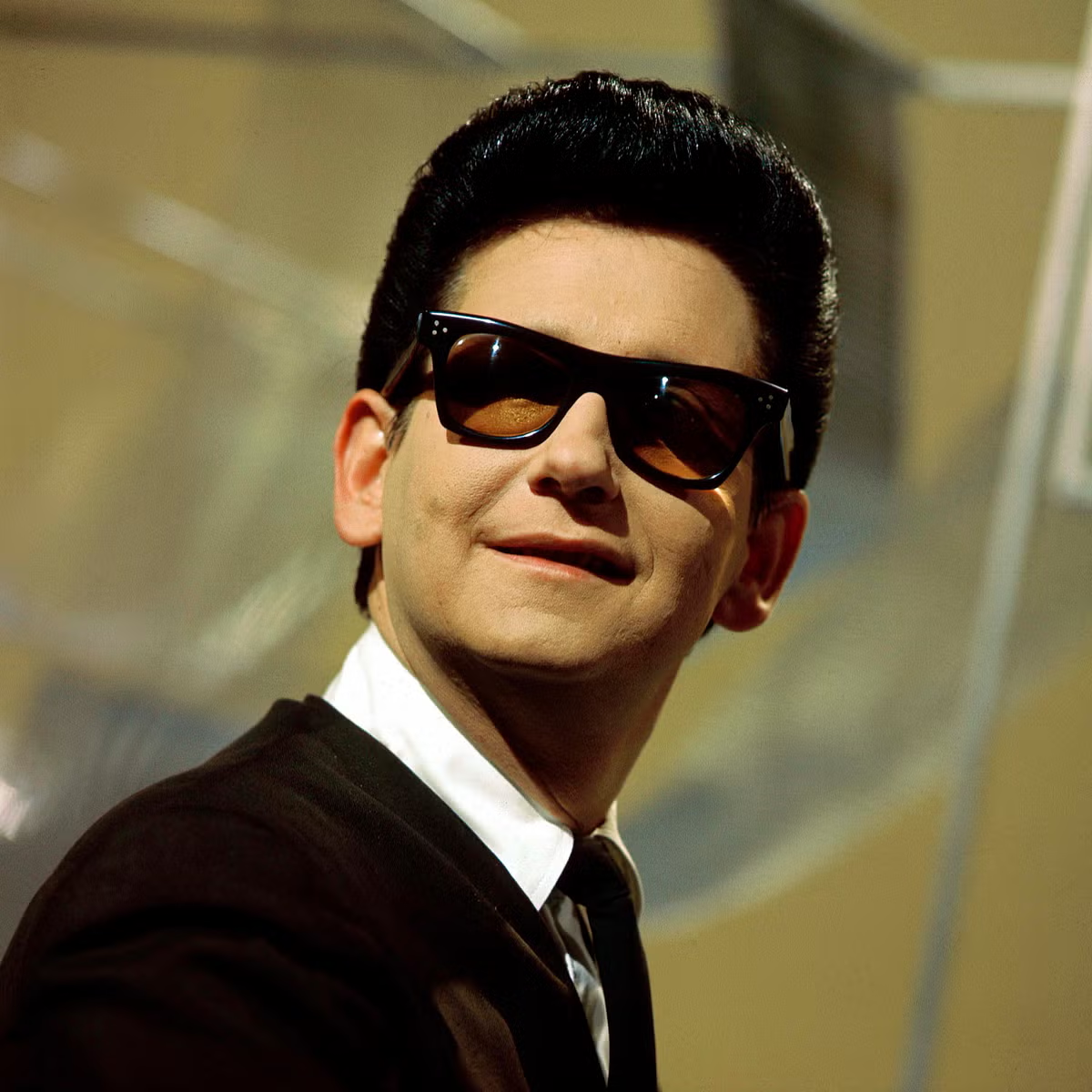
Roy Orbison performing in 1965, showcasing his trademark sunglasses and powerful stage presence. Orbison’s vocal style and songwriting set him apart from other rock singers of the time.
He possessed a remarkable multi-octave tenor voice, capable of soaring falsettos and dramatic vibrato lifts. Many of his hit songs featured unconventional structures: for example, instead of a standard verse–chorus format he might delay the chorus or omit it entirely.
Orbison described his own approach as being “blessed…with not knowing what was wrong or what was right” in writing music, which led to expressive ballads that built to emotional climaxes.
Equally distinctive was his stage image. He typically wore sharp all-black outfits and his signature dark sunglasses (originally worn to address eyesight issues), and he often stood almost motionless at the microphone. This quiet, enigmatic presence coupled with his powerful, operatic vocals created a striking contrast that became his trademark.
Career Challenges, Comebacks, And Lasting Determination
Orbison’s career faced setbacks by the late 1960s. Although he continued to record after his peak, the music scene was shifting toward new styles, and his switch to MGM Records in 1965 failed to produce hits.
He also endured severe personal hardship (including the loss of his wife and two sons in the late 1960s) that took an emotional toll. As a result, Orbison’s chart presence waned through the 1970s; he recorded sporadically (a stint on Mercury Records in 1974 and a brief return to Monument in 1976) but did not replicate his earlier success.
Despite these challenges, Orbison never retired from music. He continued performing and writing songs, and by the late 1970s he was working to revive his career. By 1980 Orbison began a major comeback. He joined the Eagles for part of their “Hotel California” tour, marking his first high-profile live work in years.
In that same period he renewed his relationship with country audiences by recording a duet with Emmylou Harris, “That Lovin’ You Feelin’ Again,” which won the pair a Grammy Award in 1981.
Other artists’ covers of Orbison songs helped rekindle interest: Linda Ronstadt scored a No. 2 hit in 1977 with her version of Orbison’s “Blue Bayou,” and the rock band Van Halen reached No. 1 on the Billboard Hot 100 in 1982 with their cover of “Oh, Pretty Woman.”
His song “In Dreams” was also featured in David Lynch’s 1986 film Blue Velvet, exposing Orbison’s music to a new audience. These successes led to a new record deal with Virgin Records and projects with prominent rock figures, heralding a full professional revival in the late 1980s.
Awards, Achievements, And Industry Recognition
Orbison’s contributions were honoured by the music industry with multiple awards and hall-of-fame inductions. He was inducted into the Rock and Roll Hall of Fame in 1987, a ceremony in which Bruce Springsteen famously praised Orbison’s operatic, emotionally complex songs.
In the same year he was also inducted into the Nashville Songwriters Hall of Fame, and in 1989 he was elected to the Songwriters Hall of Fame. Throughout his career Orbison earned five Grammy Awards (out of nine nominations). Notably, he and Emmylou Harris won the 1981 Grammy for Best Country Duo for their duet, and he and k.d. lang won in 1988 for their duet of “Crying.”
In 1991 (at the Grammy ceremony held after his death) Orbison was recognized with the award for Best Pop Vocal Performance, Male for “Oh, Pretty Woman.” The Recording Academy later honoured him with a Lifetime Achievement Award in 1998.
Influence On Rock Music And Cultural Legacy
Orbison’s artistry had a profound impact on rock music, particularly in popularising a more dramatic and emotive ballad style. His success showed that rock singers could also be interpreters of deep loneliness and heartbreak, expanding the genre beyond its usual bravado.
This is often noted by music historians and peers: Elvis Presley famously called Orbison “the greatest singer in the world,” and Springsteen highlighted that Orbison’s songs had “rhythm and movement” while addressing “the underside of pop romance.”
By openly conveying vulnerability, Orbison challenged the macho image of 1960s rock and paved the way for future singer-songwriters to explore introspective themes.
His songs have been covered by countless artists across genres from folk-rock (Don McLean’s hit cover of “Crying”) to pop (Linda Ronstadt’s “Blue Bayou” and the Traveling Wilburys’ recordings) testifying to their timeless appeal.
Orbison himself was nicknamed “The Big O” and even “The Caruso of Rock” in recognition of his operatic vocal style. He is frequently listed among the great vocalists in rock history, and his appearance (dark suit and shades) has become iconic.
Orbison’s legacy endures through the many tributes, documentaries and retrospectives that celebrate his work a testament to the unique niche he carved in rock and roll.
Later Career, Final Projects, And Lasting Public Interest
In the late 1980s Orbison enjoyed a remarkable late-career renaissance. He headlined the acclaimed concert special Roy Orbison and Friends: A Black and White Night(HBO, 1988), backed by an ensemble including Springsteen, k.d. lang, Tom Waits and others.
That year he also co-founded the rock supergroup Traveling Wilburys (with George Harrison, Jeff Lynne, Tom Petty and Bob Dylan); their debut single “Handle With Care” and album (1988) both became international hits.
At the same time Orbison was finishing work on a new solo album for Virgin. Tragically, Orbison died of a heart attack on 6 December 1988 at age 52, just after completing these final sessions.
The album, Mystery Girl(released in January 1989), became his most successful solo record. It sold over three million copies worldwide and reached No. 1 in several countries.
The lead single “You Got It” released after his death climbed into the U.S. Top 10, giving Orbison his first Top 10 pop hit in 25 years.
This posthumous success, along with the enduring popularity of the Wilburys album, kept Orbison’s music in the public eye.
In the years since his death, his songs have continued to be reissued and celebrated through anthologies, tribute concerts and covers by new artists, ensuring that Roy Orbison’s influence and fame endure well beyond his lifetime.
Roy Orbison Net Worth
At the time of his death, Roy Orbison’s net worth was not publicly disclosed, and no figure has been officially verified by major financial authorities. He earned income from record sales, songwriting and publishing royalties, and the licensing of his music for use in film and television. However, specific earnings from these sources have not been publicly disclosed.
FAQs
1. When Was Roy Orbison Born?
Roy Orbison was born on April 23, 1936, in Vernon, Texas, United States. He grew up in West Texas and showed musical interest from an early age.
2. What Was Roy Orbison Famous For?
Roy Orbison was known for his powerful voice and emotional ballads. His hit songs include “Oh, Pretty Woman,” “Crying,” and “Only the Lonely.”
3. What Was Roy Orbison’s Vocal Style?
He had a multi-octave tenor voice known for its clarity and range. His singing often featured dramatic builds and expressive high notes.
4. Did Roy Orbison Write His Own Songs?
Yes, Roy Orbison co-wrote many of his songs. He often collaborated with writers such as Joe Melson and Bill Dees.
5. What Band Was Roy Orbison Part Of Later In His Career?
In the late 1980s, he was a member of the Traveling Wilburys. The group included George Harrison, Bob Dylan, Tom Petty, and Jeff Lynne.

Chloe Anderson
Author
Chloe Anderson is a passionate explorer of the world of celebrity finance, known for her keen insights and captivating storytelling. With a background in finance journalism, Chloe has a knack for unraveling the financial mysteries behind the stars.
Her journey into the fascinating realm of celebrity net worth began with a deep curiosity about how fame and fortune intersect. Chloe believes that understanding the financial lives of iconic personalities adds a unique layer of intrigue to their captivating stories.
With a commitment to delivering accurate and engaging content, Chloe takes you on a journey through the financial successes, investments, and philanthropic endeavors of influential figures. She combines her expertise in finance with her love for storytelling to create articles and features that both inform and entertain.
Latest Articles
Popular Articles