Andrew Dice Clay Net Worth 2026: Facts & Insights
Andrew Dice Clay Net Worth analyzed with reliable details on his financial journey, major career phases, and current income sources.
Author:Chloe AndersonApr 12, 202615.4K Shares244.9K Views

Andrew Dice Clay was born Andrew Clay Silverstein on September 29, 1957, in the Sheepshead Bay neighborhood of Brooklyn, New York. He grew up in a Jewish family – his parents were Jacqueline and Fred Silverstein. His father ran a process-serving business in Brooklyn, and Clay had at least one sister in his family.
From a young age Silverstein showed a flair for performance. By about age five he was already entertaining his family with celebrity impressions. He later recalled mimicking entertainers around the house; for example, he often imitated comedian Jerry Lewis when practicing at home.
He was educated in local Brooklyn schools. Clay attended James Madison High School in Brooklyn. He did not complete a college degree.
| Fact | Details |
| Full Name | Andrew Clay Silverstein |
| Birth Date | Sept 29, 1957 |
| Birthplace | Brooklyn, New York, USA |
| Profession | Comedian, Actor |
| Net Worth 2026 | Not publicly disclosed |
| Income Sources | Stand-up, acting, writing |
| Breakthrough | Late 1980s (“Diceman”) |
| Major Achievement | Sold out Madison Square Garden (1990) |
| Notable Works | Blue Jasmine, A Star Is Born |
| Current Status | Active in comedy and acting |

Early Career And Entry Into Stand-Up Comedy
Andrew Dice Clay began performing stand-up in the late 1970s in New York City under his birth name (Andy Clay Silverstein) and the stage name Andrew Clay. He honed his early act at local clubs such as the Pips Comedy Club in Brooklyn, often incorporating impressions of pop-culture figures (for example, John Travolta’s character in Grease) into a scrappy persona.
In these beginnings he played a put-upon, nerdy character who would suddenly erupt into confident song-and-dance routines. By 1980 Clay relocated to Los Angeles to pursue wider opportunities. There he fully developed the gravelly, tough-guy character on stage, performing regularly at The Comedy Store on Sunset Strip.
In parallel with his stand-up, Clay began picking up small roles in film and television. He made his movie debut in the 1983 comedy Wacko, and later had supporting appearances in projects like John Hughes’ Pretty in Pink(1986). On TV he secured a recurring part on the NBC crime series Crime Story(1986–88). These early roles were minor, but they helped him gain industry exposure while he continued to refine his on-stage act.
The Rise Of Andrew Dice Clay And The “Diceman” Persona
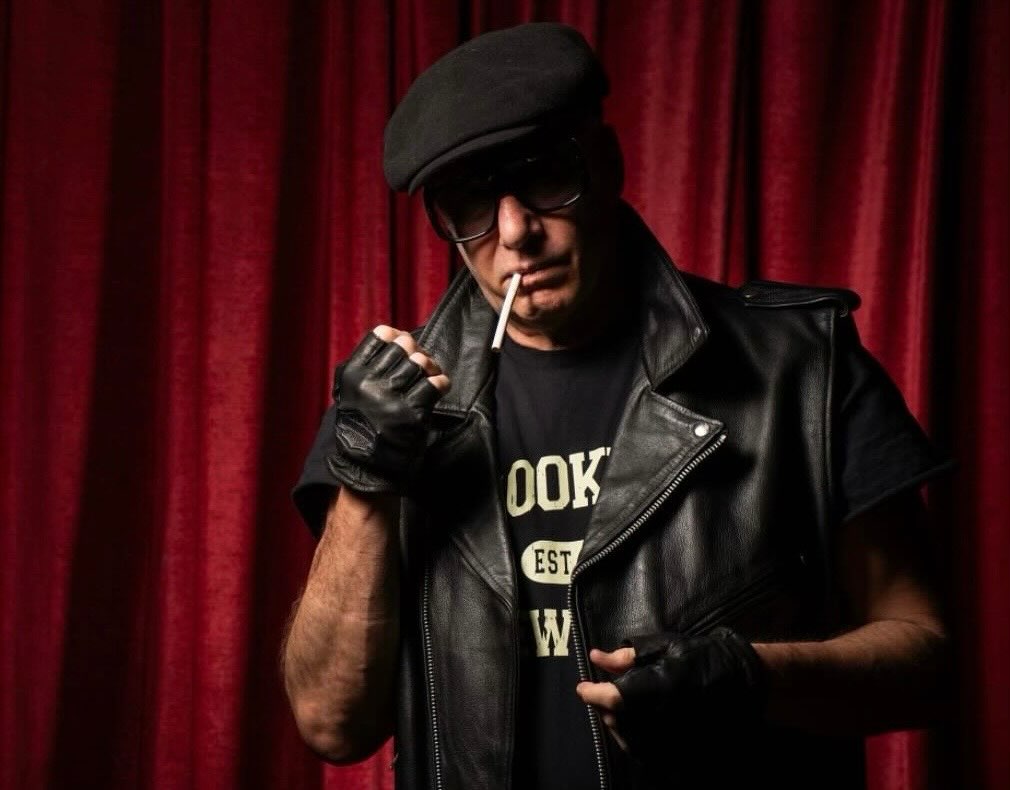
In the mid-1980s Clay fully adopted the “Diceman” persona that would define his career. He legally took the name Andrew Dice Clay and began performing as a brash, leather-jacketed Brooklyn tough character. This alter ego was a buffoonish amalgam of macho stereotypes: Clay later said the persona drew on Jerry Lewis’s Buddy Love and Travolta’s Zuko but was “cocky and rude,” emphasizing an over-the-top image of male chauvinism.
As Diceman he delivered deliberately offensive, blue-collar humor, revving up audiences with foul-mouthed nursery rhymes and one-liners. He insisted on staying completely in character on stage as Clay himself put it, “when I’m that guy, I’m that guy” signaling an unwavering commitment to the act.
This unique act began to attract national attention. In 1987 Clay appeared on Rodney Dangerfield’s HBO special (titled Nothin’ Goes Right), introducing him to a wider cable audience. By the late 1980s the Diceman character had become his primary identity: he headlined major comedy clubs across the country and became known for injecting a “rock & roll” attitude into stand-up.
Clay later reflected that he believed he could become “the biggest comic in the world” by giving audiences an image they hadn’t seen before. In this way, the Diceman persona propelled his rapid rise in the comedy scene.
Breakthrough Success And Mainstream Popularity
Clay’s career exploded in 1989–1990 as he transitioned from clubs to mainstream stardom. His debut comedy album, Dice(1989), sold exceptionally well and capitalized on the Diceman’s shock appeal. He embarked on large tours, selling out concert venues nationwide.
In February 1990 he made history by becoming the first comedian to sell out Madison Square Garden for two consecutive nights. These Madison Square Garden performances cemented his status at the top of the comedy world.
During this period Clay also branched into television and film. In early 1990 he hosted Saturday Night Live, which briefly thrust him into network television notoriety. That episode was controversial, with cast member Nora Dunn and guest Sinéad O’Connor refusing to perform due to objections over Clay’s material, but it underscored how high-profile he had become.
He starred in the feature film The Adventures of Ford Fairlane(1990), a rock-and-roll detective comedy built around his persona, though the film ultimately did not succeed at the box office. Between his gold album, sold-out stadium shows, and primetime television and movie appearances, Clay’s mainstream popularity peaked around 1990, making him one of the most recognized comedians in America at that time.
Record-Breaking Performances And Career Peak
At the height of his fame, Clay set several live performance records for stand-up comedy. Following his Madison Square Garden milestone, he continued to play very large venues.
Notably, in 1992 he headlined a show at the Rose Bowl stadium in California; this audience was reported to be the largest live crowd ever to see a comedian up to that point. Throughout this era, Clay’s stage shows typically ending with audiences chanting “Die! Die! Die!” at his cue consistently sold out arenas and amphitheaters across the United States.
The fervor around his live act was such that the media coined the term “Dicemania” to describe the phenomenon. The years 1989–1992 marked Clay’s career peak, characterized by unprecedented ticket sales and record-breaking attendance for a stand-up performer.
Controversy And Its Impact On His Career
Clay’s rise was paralleled by intense controversy, which began to affect his career trajectory by the early 1990s. His deliberately offensive material drew sharp criticism from many quarters.
In late 1989, after Clay performed segments of his act at the MTV Video Music Awards, MTV banned him from future appearances, a move widely noted at the time. His style of humour, which was openly misogynistic and profane, led to protests by women’s groups and others.
The fallout from his Saturday Night Livehosting in 1990 with cast member Nora Dunn and guest Sinéad O’Connor refusing to appear was a highly publicized example of this backlash.
These controversies began to erode his broad appeal. By some accounts, the very content that had built his reputation caused segments of the media and public to turn away.
Although Clay never apologized or significantly changed his act, the early 1990s saw shifting public tastes. Ultimately, the heightened scrutiny and protests contributed to a cooling of Clay’s mainstream popularity after 1991, even as he remained a draw for live audiences.
Transition From Stand-Up To Acting Roles
By the mid-1990s Clay chose to step back from the Diceman character and focus more on acting. In 1995 he starred in the CBS sitcom Bless This House, marking a deliberate turn toward situational comedy and more family-oriented roles.
That series ran for one season before cancellation. Through the late 1990s, Clay appeared in a string of feature films, mostly in supporting or co-starring roles. These included Brain Smasher... A Love Story(1993), No Contest(1995), Whatever It Takes(1998), and Foolish(1999).
At the same time he continued to perform stand-up tours, albeit less frequently than before. By around 2000, Clay had largely withdrawn from both major media and stand-up for a period.
His later appearance on Celebrity Apprentice 2in 2009 marked one of his notable television returns during this phase. The late 1990s and early 2000s represented a transitional period in which Clay expanded into acting while reducing his visibility as a headline stand-up performer.
Career Comeback And Reinvention In Hollywood
Beginning in the 2010s, Andrew Dice Clay experienced a resurgence as a character actor. In 2011 he appeared on the final season of HBO’s Entourage, playing a version of himself.
This performance led to further opportunities, including a significant supporting role in Woody Allen’s Blue Jasmine(2013), where he portrayed a working-class character in a dramatic context. The role was widely recognized for demonstrating range beyond his earlier comedic persona.
Following this, Clay appeared in the television series Vinyl(2016) and co-created and starred in the Showtime series Dice(2016–2017), a semi-autobiographical comedy centered on his career.
He also took on supporting roles in major productions, including A Star Is Born(2018) and the series Pam & Tommy(2022). These performances established him as a consistent presence in film and television, separate from his original stand-up identity.
Current Work, Recent Projects, And Professional Activities
As of recent years, Andrew Dice Clay remains active in both stand-up comedy and acting. He continues to tour and perform live shows, maintaining a steady presence on the comedy circuit. In addition to live performances, he engages audiences through digital platforms and long-form content, including podcasting and social media-based comedy.
In film, he has continued to take on supporting roles in new productions, including involvement in upcoming projects such as The Pickup, reflecting ongoing demand for his work in ensemble casts. His recent career reflects a sustained dual focus on live comedy and screen acting, with a professional trajectory that spans multiple decades in the entertainment industry.
Andrew Dice Clay Net Worth
As of 2026, Andrew Dice Clay’s net worth has not been publicly disclosed, and no official figure has been verified by major financial authorities. He continues to generate income through live stand-up comedy performances and acting roles in film and television. In addition, he earns from writing and production contributions to his entertainment projects. However, specific earnings from these activities remain undisclosed.
FAQs
1. Who Is Andrew Dice Clay?
Andrew Dice Clay is an American stand-up comedian and actor known for his controversial “Diceman” stage persona. He rose to fame in the late 1980s with a bold, edgy comedy style.
2. What Is Andrew Dice Clay Famous For?
He is best known for his “Diceman” character, which featured aggressive, blue-collar humor and provocative nursery rhyme routines. His performances helped redefine arena-level stand-up comedy.
3. When Did Andrew Dice Clay Start His Career?
Andrew Dice Clay began performing stand-up comedy in the late 1970s in New York City. He later moved to Los Angeles to expand his career opportunities.
4. What Are Andrew Dice Clay’s Most Notable Works?
His notable works include stand-up specials and films such as The Adventures of Ford Fairlaneand Blue Jasmine. He has also appeared in A Star Is Bornand Pam & Tommy.
5. Did Andrew Dice Clay Achieve Any Major Milestones In Comedy?
Yes, he became the first comedian to sell out Madison Square Garden for two consecutive nights in 1990. This achievement marked a significant moment in stand-up comedy history.

Chloe Anderson
Author
Chloe Anderson is a passionate explorer of the world of celebrity finance, known for her keen insights and captivating storytelling. With a background in finance journalism, Chloe has a knack for unraveling the financial mysteries behind the stars.
Her journey into the fascinating realm of celebrity net worth began with a deep curiosity about how fame and fortune intersect. Chloe believes that understanding the financial lives of iconic personalities adds a unique layer of intrigue to their captivating stories.
With a commitment to delivering accurate and engaging content, Chloe takes you on a journey through the financial successes, investments, and philanthropic endeavors of influential figures. She combines her expertise in finance with her love for storytelling to create articles and features that both inform and entertain.
Latest Articles
Popular Articles